
Grinding metal is only one of the many applications of the heavy-duty angle grinder. Depending on the type of grinding disc installed in the machine, it can be used for cutting, cleaning, shaping, deburring, and finishing different materials. The secret is to adjust the machine parameters to the task.
Here at Ralli Wolf, we manufacture angle grinders suitable for different needs, from small 100 mm angle grinders to those intended for heavy-duty workshop tasks. Knowing when and how to use your power tool will enable you to maximise its benefits.
The versatility of an angle grinder comes from its ability to work with different accessories and accommodate different applications. However, not every grinder is designed for the same workload.
For lighter repair work, a compact grinder can provide easier handling and sufficient power for cutting and grinding. More demanding fabrication may call for a heavy-duty angle grinder with higher power and a larger disc capacity.
Speed is another important consideration. When a project involves both material removal and finishing, an angle grinder with speed control can provide greater flexibility by allowing the operator to adjust the working speed according to the application and accessory.
Cutting is one of the most practical uses for an angle grinder. In a home workshop, it can be used for cutting metal rods, bolts, brackets, pipes and other suitable metal sections. In fabrication environments, it can help prepare components before assembly or welding.
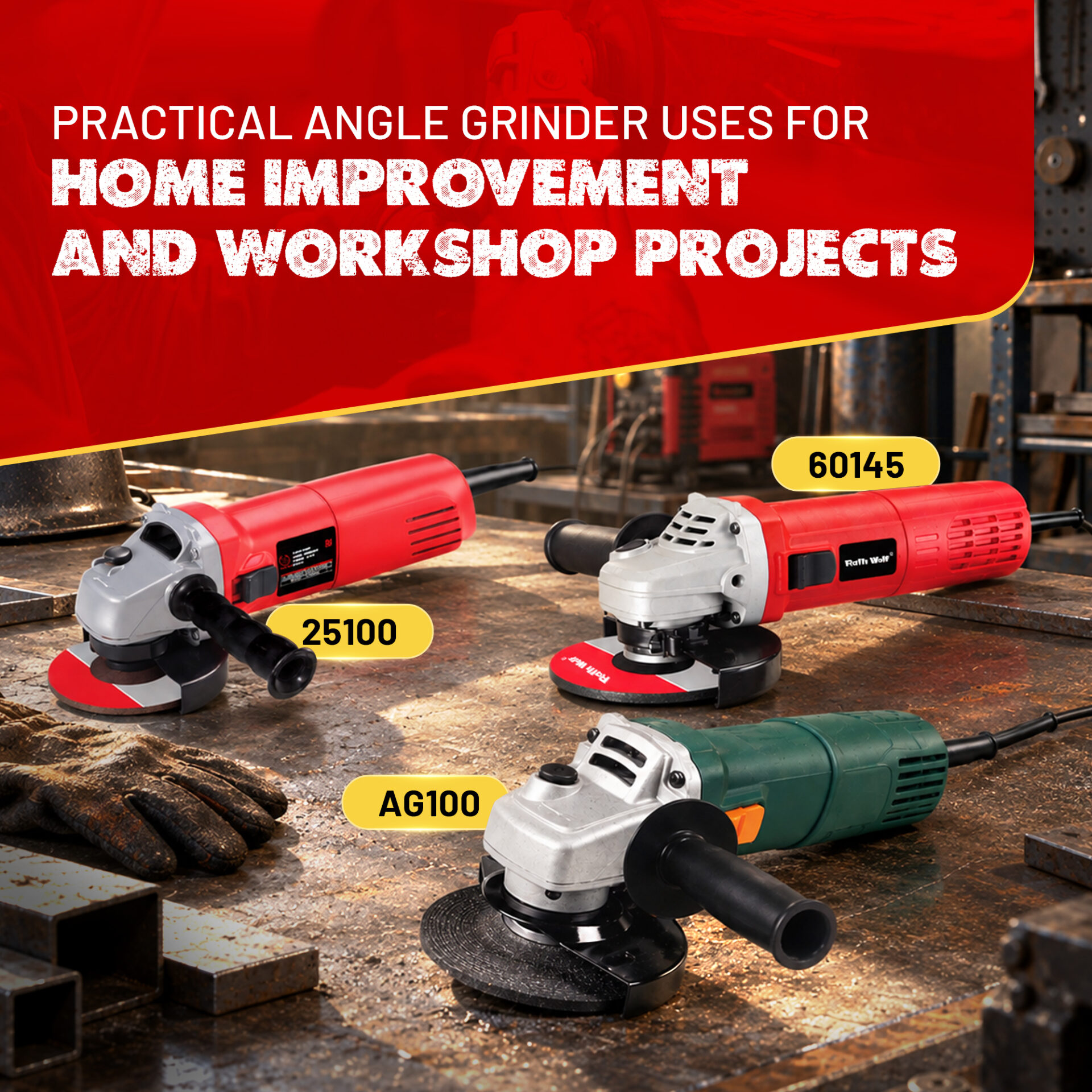
The Ralli Wolf’s 25100 is a 100 mm angle grinder which has an 800 W motor and 11,000 RPM as its maximum speed, thus being applicable for those situations where small size and fast performance are needed.
There is also an AG100 with a 100 mm disc which has a 1100 W motor and 11000 RPM as its maximum speed. The selection of tools depends upon the material and conditions of the work and not only the power.
Removing Rust, Paint and Surface Buildup
Before painting, welding or refinishing metal, surface preparation is often the first job. An angle grinder fitted with the appropriate accessory can remove rust, old coatings, scale and other surface buildup.
This is where control becomes particularly valuable. An angle grinder with speed control allows users to work at different speeds instead of relying on a single fixed operating speed. The ability to adjust speed can be useful when moving between aggressive material removal and more controlled finishing applications.
The accessory still matters just as much as the grinder. Always use a wheel or attachment designed for the specific material and application.
Weld Dressing and Metal Fabrication
In fabrication, a heavy-duty angle grinder is frequently used after welding to dress welds, remove excess material and prepare surfaces for subsequent operations. The objective is not simply to remove material quickly but to achieve the required finish without unnecessarily damaging the surrounding surface.
For repeated fabrication work, a heavy-duty angle grinder can offer the power and construction required for more demanding workloads. Ralli Wolf’s range includes angle grinders across different disc sizes and power classes, allowing workshops to select equipment according to the scale of their applications.
The right combination of grinder, abrasive and technique can make weld preparation considerably more consistent.
Grinding is where an angle grinder earns its name, but the application extends beyond simply smoothing a surface. It can help remove sharp edges, clean up rough cuts, shape suitable metal components and eliminate burrs after fabrication.
For these jobs, disc diameter and motor power influence how the tool handles the workload. Smaller grinders can be convenient for general workshop work, while larger formats can be appropriate when greater material removal is required.
As experienced grinding machine manufacturers, we understand that tool selection needs to be application-specific. Power, disc capacity, operating speed, handling and protection features all have a role in determining the right machine.
Polishing and Finishing
With compatible accessories, an angle grinder can also support polishing and finishing applications. However, these jobs require a different approach from aggressive grinding.
High-speed grinding is not automatically suitable for every finishing application. Controlling the operating speed can help users adapt the tool to the accessory and desired finish.
Ralli Wolf’s angle grinder 60145 is particularly relevant here. It combines a 1400W motor with variable speed from 3,000 to 11,000 RPM, along with soft start and electronic overload protection. These features make it a versatile option when an angle grinder with speed control is required for applications involving different working speeds.
Different jobs demand different combinations of power, control and disc capacity. That is why our angle grinder range is built across multiple formats rather than around a single machine.
From compact 100 mm grinders for everyday workshop requirements to high-power options for demanding applications, Ralli Wolf provides tools for cutting, grinding, fabrication and finishing. Models such as the 60145 also bring variable-speed operation and protective features to applications where greater control matters.
Our experience as grinding machine manufacturers informs an application-focused approach: the right tool is the one that fits the work.
From cutting metal at home to dressing welds in a workshop, an angle grinder is a versatile power tool. The right disc, power, size and speed make all the difference.
Whether you need a heavy-duty angle grinder for demanding fabrication or an angle grinder with speed control for greater flexibility, Ralli Wolf offers tools for varied workshop applications.
Choose the right tool and accessory for the job, and make your Ralli Wolf angle grinder a reliable part of your workshop.
FAQs
Angle grinders are important when it comes to tasks such as welding grinding, metal and masonry cutting, de-rusting, finishing of rough edges, surfacing, and polishing. Angle grinders can be helpful when used with the appropriate accessories in the process of manufacture, construction, maintenance, and workshop applications. Use the accessory that is specific to the particular application.
OSHA guidelines require machine guarding and a properly installed guard, matching speeds of wheel and grinder, and examination of grinding wheels prior to installation. OSHA also demands the use of suitable eye and face protection. Employees need to install accessories as per guidelines and never exceed the accessory’s maximum rated speed.
Safe grinders are those which have proper guards, correct accessories, right speeds and control systems. Such grinders are to be regularly checked and maintained and operators should wear appropriate PPE and adhere to manufacturer guidelines. In case of abrasive-wheel grinders, the OSHA guidelines highlight the issue of proper guarding, inspection and speed rating.

Ralli Wolf, one of the torchbearers in power tool production in India, started its journey more than 60 years ago in collaboration with Wolf UK. Six decades down the line, the company remains firmly committed to providing comprehensive, high-quality solutions across a wide range of segments, including Power Tools, Farm Equipment, Pneumatic Tools, Welding Equipment, Motors, and Accessories.