
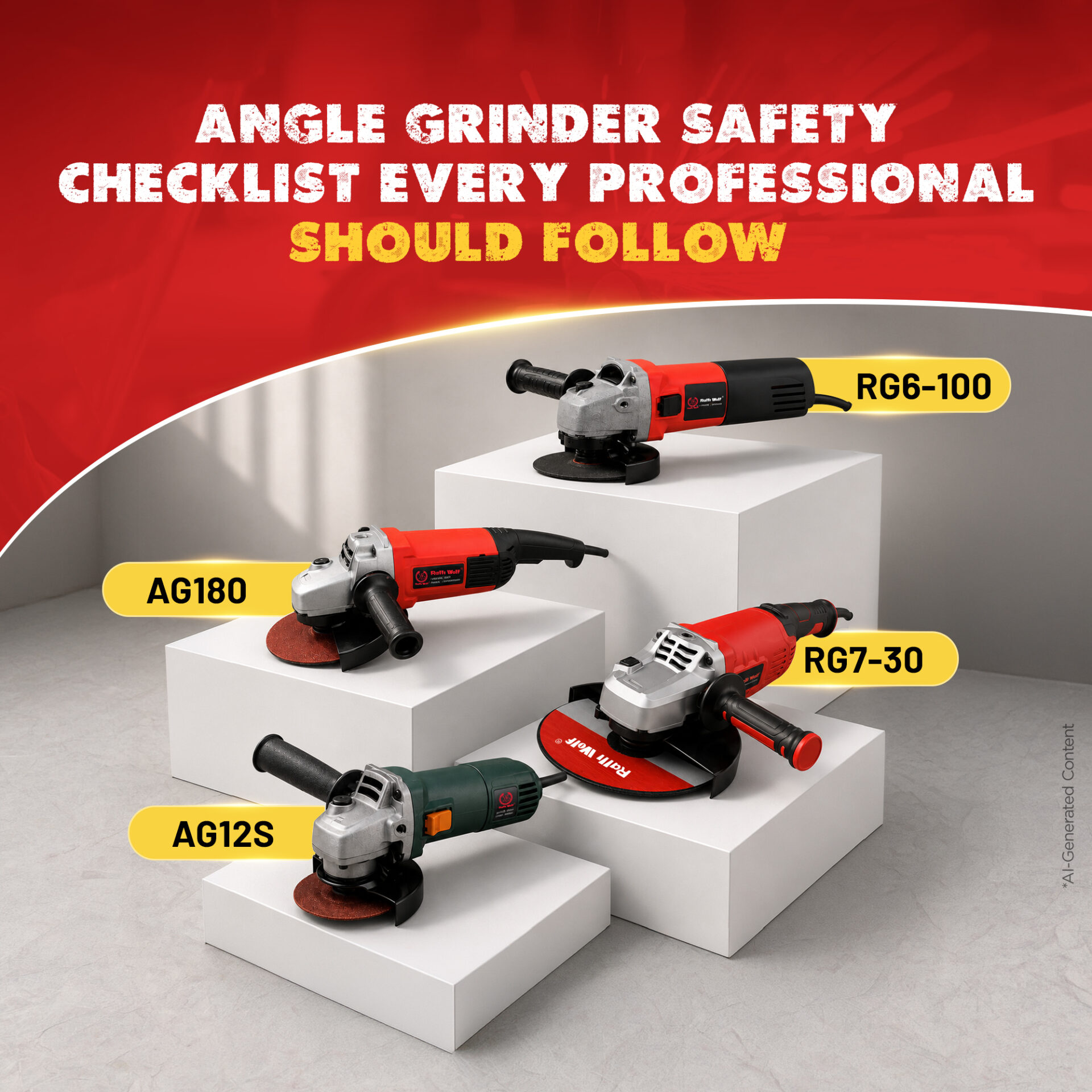
It is imperative to have an angle grinder when dealing with industrial maintenance, metal work, construction, and fabrication. Having the right angle grinder with speed control makes one able to deal with difficult applications such as cutting materials and welding.
However, a heavy-duty angle grinder is also a power tool with high speed. It takes more than just turning it on to operate safely. The grinder’s state, the choice of accessories, the guarding, the operating speed, the workplace, and the operator’s technique are all important factors.
At Ralli Wolf, we create angle grinders with features like variable speed, soft start, electronic overload protection, restart protection, and motor dust protection for demanding professional applications.
This is a useful safety checklist for heavy-duty angle grinders that all professionals should use.
Before every operation, make sure the grinder is free of visible damage. Examine the handles, switch, plug, power cable, housing, and other easily accessible parts.
Even if a rugged angle grinder is designed for tough jobs, pre-use inspection must take place. It makes no sense to use an angle grinder with speed control if the machine has loose parts or faulty electrical elements.
Verify that the proper wheel guard is in place, safe, and undamaged. For appropriate abrasive-wheel machinery, guarding is a basic necessity. According to OSHA regulations, abrasive wheels must have the proper safety guards installed and positioned. Never take down a guard just to make things easier. (osha.gov)
Before mounting the grinding or cutting wheel, look for visible damage such as chips, cracks, or deformation.
According to OSHA regulations, abrasive wheels must be inspected prior to mounting, and the machine speed must be compared to the wheel’s maximum operating speed. (osha.gov)
Don’t use an accessory if it’s damaged or in doubt.
Make sure the grinder is compatible with its maximum rated operating speed and that the accessory is suitable for the grinder at all times.
This is especially crucial when using an angle grinder with speed control. Variable speed provides flexibility, but this does not mean that an accessory can be used beyond its rated limit.
Keep a steady posture and firm control of the grinder once it is operating. Don’t apply too much pressure. Allow the proper accessory to do the work rather than forcing the grinder into the material.
Particularly when cutting, pay close attention to kickback and binding. The tool may move unexpectedly due to an abrupt obstruction or pinching of the accessory.
If you observe any unusual vibration, noise, overheating, loss of control, or other abnormal behaviour, stop right away.
Never:
The grinder and accessory manufacturer’s instructions should always be used to determine the appropriate guard, accessory, and operating procedure.
After the task is finished, turn off the grinder and keep control until the wheel has completely stopped.
When the accessory is still rotating, do not set the grinder down. Examine the grinder and any accessories for wear or damage after use. Remove any faulty accessories from service and clean and store the tool in accordance with the manufacturer’s instructions.
Prior to the next operation, routine inspection aids in identifying issues.
Before grinding with the tool, it is imperative that the process of safe grinding starts. It is important to pick the right accessories, guard the process well, and maintain correct speeds while working. All this applies whether you have an angle grinder with speed control for versatility or a heavy-duty angle grinder for tough tasks.
Our selection of Ralli Wolf includes angle grinders that incorporate motor dust protection, variable speed, soft start, overload protection, and restart protection.
The professional user must choose the right model of the Ralli Wolf angle grinder according to the application, disc size, and operating requirements and safety needs.
Inspect. Protect. Control. Use properly. For professionals, safety is the first step in professional grinding.
FAQs
Angle grinders are important when it comes to tasks such as welding grinding, metal and masonry cutting, de-rusting, finishing of rough edges, surfacing, and polishing. Angle grinders can be helpful when used with the appropriate accessories in the process of manufacture, construction, maintenance, and workshop applications. Use the accessory that is specific to the particular application.
OSHA guidelines require machine guarding and a properly installed guard, matching speeds of wheel and grinder, and examination of grinding wheels prior to installation. OSHA also demands the use of suitable eye and face protection. Employees need to install accessories as per guidelines and never exceed the accessory’s maximum rated speed.
Safe grinders are those which have proper guards, correct accessories, right speeds and control systems. Such grinders are to be regularly checked and maintained and operators should wear appropriate PPE and adhere to manufacturer guidelines. In case of abrasive-wheel grinders, the OSHA guidelines highlight the issue of proper guarding, inspection and speed rating.

Ralli Wolf, one of the torchbearers in power tool production in India, started its journey more than 60 years ago in collaboration with Wolf UK. Six decades down the line, the company remains firmly committed to providing comprehensive, high-quality solutions across a wide range of segments, including Power Tools, Farm Equipment, Pneumatic Tools, Welding Equipment, Motors, and Accessories.