Although each weld is different, the quality of the welding machine determines the quality of the weld. There are other considerations that need to be made before choosing the right arc welding machine. Understanding how the machine will be used is important for consistency and productivity.
We at Ralli Wolf have been offering industrial welding solutions to satisfy the shifting needs of numerous industrial sectors. Our vast array of transformer, rectifier, and inverter-based welding equipment is designed to accurately and reliably support a variety of industrial applications.
In this buying guide, we’ll cover all the information you require about an ARC welding machine.
An arc welding machine is a device that uses an electric arc generated between an electrode and a workpiece to produce heat required for melting and joining metals. In the context of industrial use, control of penetration, reduction of spatter, and maintenance of arc stability rely on consistent power input. In addition, the machine requires a proper duty cycle, power source, electrode diameter, and current. This makes ARC welding tools an integral part of the whole production process, rather than just a machine.
Verify the output-current range
Whether a machine can support the necessary electrode and welding application depends on its current range.
A 200- or 250-amp model might be adequate for general workshop tasks and minor repairs. A 400-, 500-, 600-, or 630-amp machine might be more suitable for high-penetration welding, heavy sections, or structural fabrication.
Don’t just choose maximum amperage. Within the range that your operators currently use most frequently, the machine should run steadily.
Understand the duty cycle
Ralli Wolf’s welding machine’s duty cycle shows how long it can weld for before needing to cool down.
Many industrial applications can benefit from a 60% duty cycle, but continuous or automated work may necessitate paying closer attention to the machine’s 100% duty-cycle output.
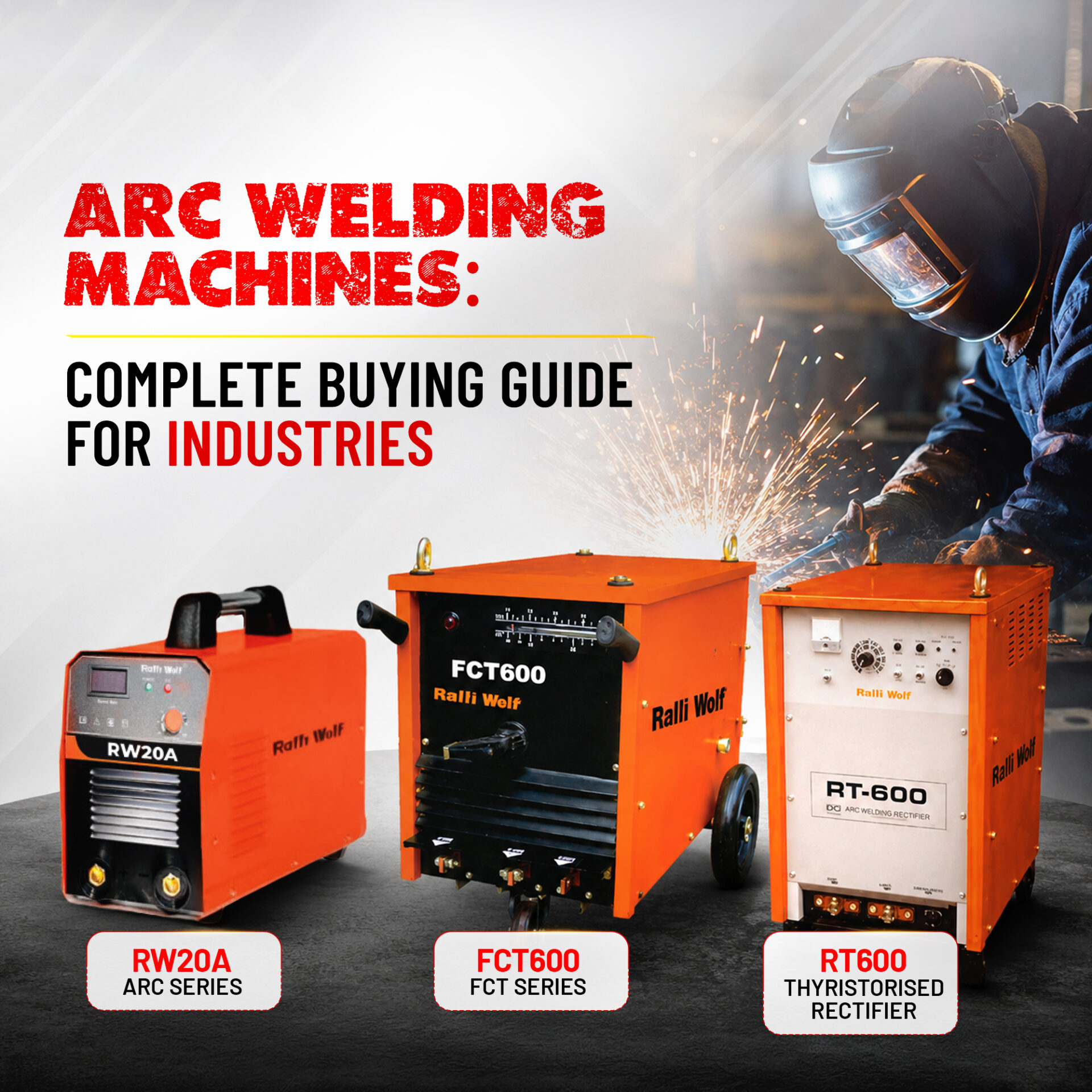
The RA60E, for instance, provides 460 A at 100% duty cycle and 600 A at 60% duty cycle. The RT600 offers 470 A for automated welding at 100% and 600 A for manual welding at 60%. Buyers can compare headline output with sustained operating capacity with the aid of these numbers.
Match the electrical supply
Installation delays and needless expenses may result from a machine that does not match the site supply.
Confirm:
Single-phase 230 V supplies power the RW20A and ECO 200N, whereas three-phase 415 V supplies power the RA63 and RT Series. For locations with different operating conditions, the RA25D and RA40GT offer more supply options.
Consider portability sincerely
Machine weight is not the only factor in portability. Additionally, it influences the practical distance between the power source and the weld joint, operator mobility, and setup time.
Between maintenance locations, a 4 kg Ralli Wolf welding machine is easily transportable. A different class of machine, the 145 kg RT600 or 150 kg FCT600, is designed for high-output industrial deployment instead of frequent manual relocation.
Depending on the real workflow, select mobility. When a portable unit’s output and duty cycle still satisfy the job requirements, it becomes valuable.
Verify process compatibility
Not all ARC welding machines are designed for the same set of processes.
The RA60E is intended to be a constant-current power source for TIG and MMA welding. With the right accessories, manual MMA and DC TIG are supported by the RT400 and RT600. In appropriate higher-amperage applications, the RA50 can support gouging and TIG with optional equipment. The FCT machines are AC transformer-type MMAW power sources.
Before purchasing the machine and related arc welding tools, buyers should verify the necessary procedures.
Instead of ideal laboratory conditions, industrial equipment must function in actual electrical and environmental conditions.
Our inverter machines come with features like these, depending on the model:
The site, the location of the machine, and the operating procedure will determine the necessary feature set.
There is no one-size-fits-all welding machine because different industries have different welding requirements.
| Type | Technology | Output Range | Best Suited For | Ralli Wolf Models |
| Inverter Arc Welding Machines | IGBT/MOSFET Inverter Technology | 200 A–630 A | Maintenance, fabrication, construction, mobile welding, heavy engineering | RW20A, ECO-200N, RA20, RA25, RA25D, RA30D, RA40GT, RA40H, RA50, RA60N, RA63 |
| Thyristor Rectifier Welding Machines | SCR (Thyristor) Controlled DC Output | 400 A–600 A | Heavy fabrication, shipbuilding, railways, oil & gas, DC TIG welding, gouging | RT400, RT600 |
| Transformer Arc Welding Machines | Moving-Core AC Transformer | 400 A–600 A | Steel plants, infrastructure, heavy construction and industrial workshops | FCT400, FCT600 |
We have been creating equipment for Indian factories, workshops, and project sites for over 60 years. Our goal is not to provide a single machine to meet every need. Its purpose is to provide an organised range from which every industry can choose the appropriate configuration, technology, and capacity.
The moment one selects the arc welding machine with utmost care, it no longer becomes a simple energy supplier. Instead, it becomes an integral part of the production process, serving the user, ensuring the quality of the output and maintaining efficiency.
Understanding your application, workload, and operational requirements is the first step in selecting the ideal arc welding machine.
You can invest in a solution that offers dependable performance and long-term value by assessing elements like output range, duty cycle, power supply, and compatible arc welding tools.
Our extensive selection of inverter, rectifier, and transformer-based welding equipment at Ralli Wolf is designed to satisfy a variety of industrial requirements. Explore our range to find the Ralli Wolf welding machine that best fits your application and helps you weld with confidence.
FAQs
The most essential aspects of welding are correct electrode size, current, arc length or voltage, travel speed, and electrode angle. These are things that you must know about the welding machine to achieve better results.
You must first take your projects and needs into account when selecting an arc welding machine. Then you should consider the Current Range and Duty Cycle. Of course, it is followed by features and controls.
One such common and very effective welding process is the submerged arc welding process, which is widely known because of the high rate of deposition. The submerged arc welding machine process is an automated and continuous process. Hence, thick sections of the materials can be welded.

Ralli Wolf, one of the torchbearers in power tool production in India, started its journey more than 60 years ago in collaboration with Wolf UK. Six decades down the line, the company remains firmly committed to providing comprehensive, high-quality solutions across a wide range of segments, including Power Tools, Farm Equipment, Pneumatic Tools, Welding Equipment, Motors, and Accessories.